Should I refinance? Cashback, break fees and offset explained
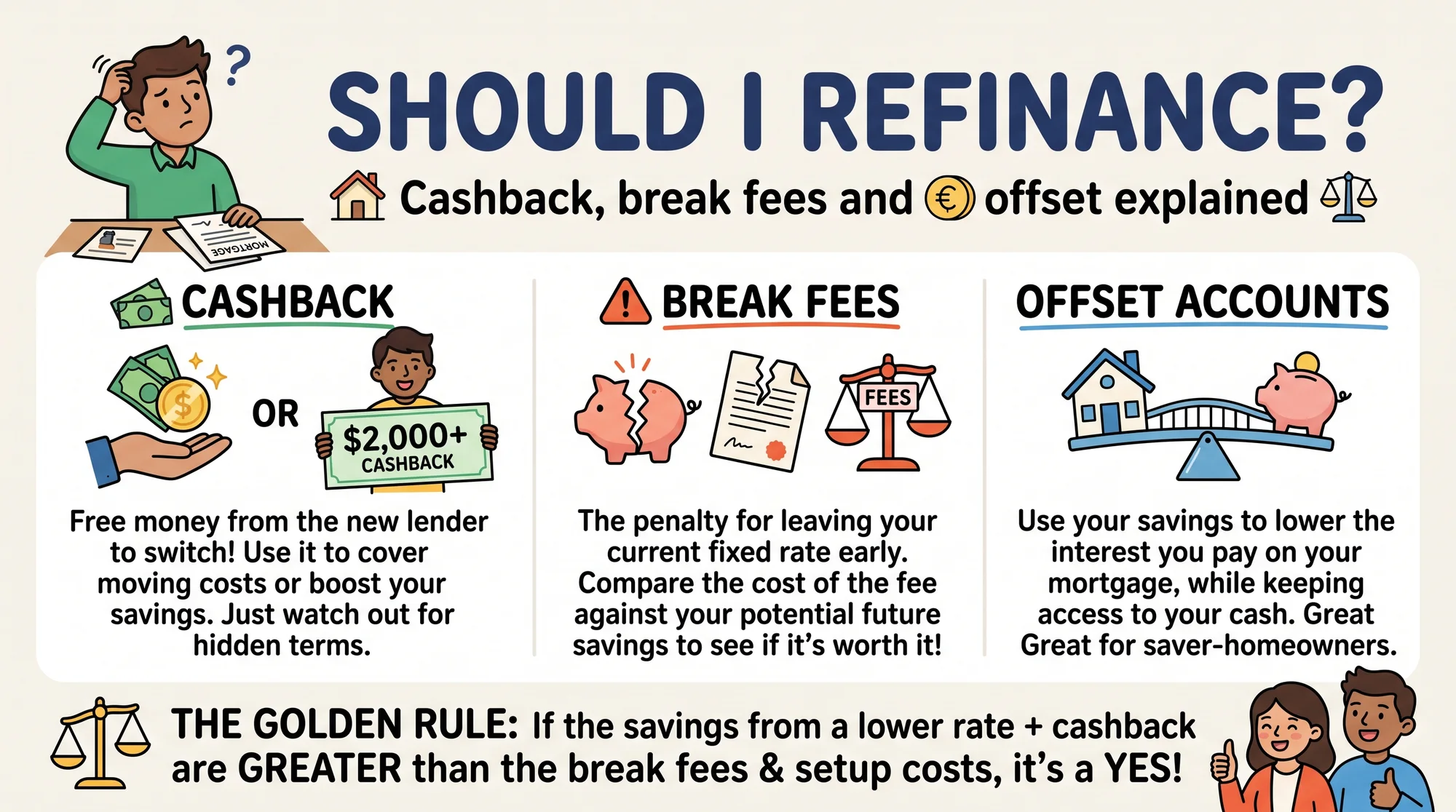
Refinancing means moving your mortgage to another lender, usually for a lower rate, a cashback, or a structure your current bank will not offer. Done at the right moment it can be worth a lot. Done inside a fixed term it can cost more than it saves. Here is how to tell.
Start with the rate
The saving from a lower rate is interest you never pay, and over a long loan it is bigger than most people expect. A $650,000 loan at 6.5% with 300 months to run, repaid at $4,400 a month plus $500 extra, saves $172,854 of interest if it moves to 4.99% and the repayments stay the same. Keeping the repayment where it was is the point: a lower rate with the same payment clears the loan sooner. Check what lenders are offering today on Today's Best Rates; those are published rates, and an adviser can often do better.
Cashback
Lenders offer a cash contribution to win a loan, typically a share of the amount borrowed. It is real money, but it comes with a claw-back: leave the lender within the agreed period, often three or four years, and you repay some or all of it. So a cashback is worth taking only if the rate is also right, and you should treat it as covering the cost of moving (legal fees, a discharge fee, sometimes a valuation) rather than as a windfall. The calculator below estimates cashback at 1% of the loan less $1,500 of switching costs, and you can overtype it with the actual offer.
Break fees
If you are part-way through a fixed term, the lender can charge a break fee. It is not a penalty for leaving; it is the lender's cost of being repaid early when wholesale rates have fallen since you fixed, roughly the gap between your fixed rate and the current rate for the time you had left, on your balance. If rates have risen since you fixed, the fee is often nil. Ask your lender for the figure in writing before you decide; it can be a few hundred dollars or many thousands. The calculator does not include break fees, so put the quoted fee against the saving yourself.
The clean moment to refinance is when a fixed term ends. In the example above, 12 months of the fixed term are left, so the saving is what you would get by moving then.
Offset
An offset account links your everyday money to the loan: interest is charged on the loan balance less what is in the account, so $15,000 of savings sitting against a $650,000 loan means interest on $635,000. The money stays available. Because the loan's interest rate is higher than any savings rate and the saving is not taxed, offsetting beats earning interest on the same money. With the $5,000 cashback also paid off the loan, the same example saves $388,410 of interest and clears the loan 115 months sooner. For more on how offset accounts work and who they suit, see What is an offset mortgage?.
Compare the three paths
Enter your mortgage as it is today and the rate you could move to. The calculator shows staying put, switching to the new rate, and switching with the cashback and an offset, and reports the interest saved and the months cut from the loan on each.
Rate check
Would refinancing save you money?
Your mortgage today against a switch to today's rate for your fixed term, with an offset account working for you.
Your optimal solution
You could save up to
and pay your mortgage off 10 yr 2 mo sooner.
Cashback and offset
- Cashback (1% less $1,500 legal costs)
- $5,000
- Offset opening balance
- $20,000
- Monthly top-up to the offset
- $1,254
- What you actually pay each month
- $4,900
Time saved is measured against your loan's current remaining term. Cashback assumes 1% of your balance less $1,500 legal costs; lender offers vary. Estimate only.
Loan balance over time
Your optimal solution shows what you owe less your offset account, so it reaches $0 the month the offset covers the loan.
Today vs your new loan vs your optimal solution
Each loan ends when it is paid off.
Comparison table
| Measure | Your loan todayCurrent rate 6.5% | Your new loanNew rate 4.59% | Your optimal solutionRecommendedNew rate 4.59% + keep your current repayment + pay extra |
|---|---|---|---|
| Minimum monthly repayment | $4,389 | $3,646 | $3,646 |
| Your actual repayment | $4,400 | $3,646 | $4,400 |
| Payoff time | 24 yr 11 mo | 25 years | 14 yr 10 mo |
| Total interest amount | $661,669 | $443,859 | $238,738 |
| Interest saved (from your loan today) | — | $217,810 | $422,932 |
| Time saved | — | — | 10 yr 2 mo |
Interest saved over time
"Your loan today" vs "Your optimal solution" - cumulative interest saved at each point.
1 year
$13,650
2 years
$28,002
3 years
$43,076
Whole term
$422,932
Loan balance over time
Your optimal solution shows what you owe less your offset account, so it reaches $0 the month the offset covers the loan.
Today vs your new loan vs your optimal solution
Each loan ends when it is paid off.
When refinancing is not worth it
A break fee larger than the first few years of saving, when you could simply wait for the term to end.
A small loan or a short time left: the rate difference has little to work on.
A cashback you would have to repay because you expect to sell or move again inside the claw-back period.
A change in your circumstances since you last applied, so that a new lender would decline or test you harder.
If the numbers are close, the structure may matter more than the lender. The Offset Saver calculator shows what an offset alone would do on your loan.