
Skip to content
EnhancedMortgage

How Much Can I Borrow?Borrowing calculator

A lender applies three limits: what you can repay from your surplus at an assessment rate, six times your household income, and the loan your deposit is enough for. Enter your incomes, living costs, debts and savings and this calculator works out all three, gives you a borrowing range and a purchase budget, and shows which limit is holding you back.

Borrowing estimate

How much could I borrow for my first home?

Your income, costs and deposit against the three limits a lender applies.

Who is applying

Per year, before tax
Children or others you support

Monthly costs

A suggestion for your household - replace it with your own figure. Excludes rent and mortgage. Suggested at $1,900 for one adult, $2,600 for a couple, plus $500 a dependant.
Car loans, buy-now-pay-later, student loan - not credit cards
Every card's limit, used or not - banks count 3% of it a month
Still owed on other loans, cards left out - counts towards the 6 times income limit

Deposit

Savings, gifts, other funds
Optional
The banks' average test rate from Rates Hub: 6.88% across 7 lenders, as at 17 Nov 2026. Tick the box to enter your lender's own.

Assumptions

  • The loan is tested at the assessment rate (6.88%) over 30 years, principal and interest.
  • Income tax is worked out per applicant with the IRD brackets, plus the ACC earners' levy of 1.75% on earnings up to $156,641.
  • KiwiSaver of 3.5% of income is deducted only for members.
  • Living costs are your own figure. The suggestion is the cautious end of the living-cost benchmarks New Zealand mortgage advisers use for bank minimums: $1,900 a month for one adult, $2,600 for a couple, plus $500 a dependant. Banks use their own figures, and your actual spending if it is higher.
  • Banks count 3% of your credit card limits as a monthly repayment, even if you owe nothing on them.
  • $100 a month is kept back as a buffer.
  • Everything you owe, the new loan and credit card limits included, is capped at 6 times household income before tax (a Kāinga Ora First Home Loan is exempt), and the loan by a minimum deposit of 20% (5% with a Kāinga Ora First Home Loan).
  • The range runs from 90% of the estimate to the estimate, rounded down to $10,000.

Your estimate

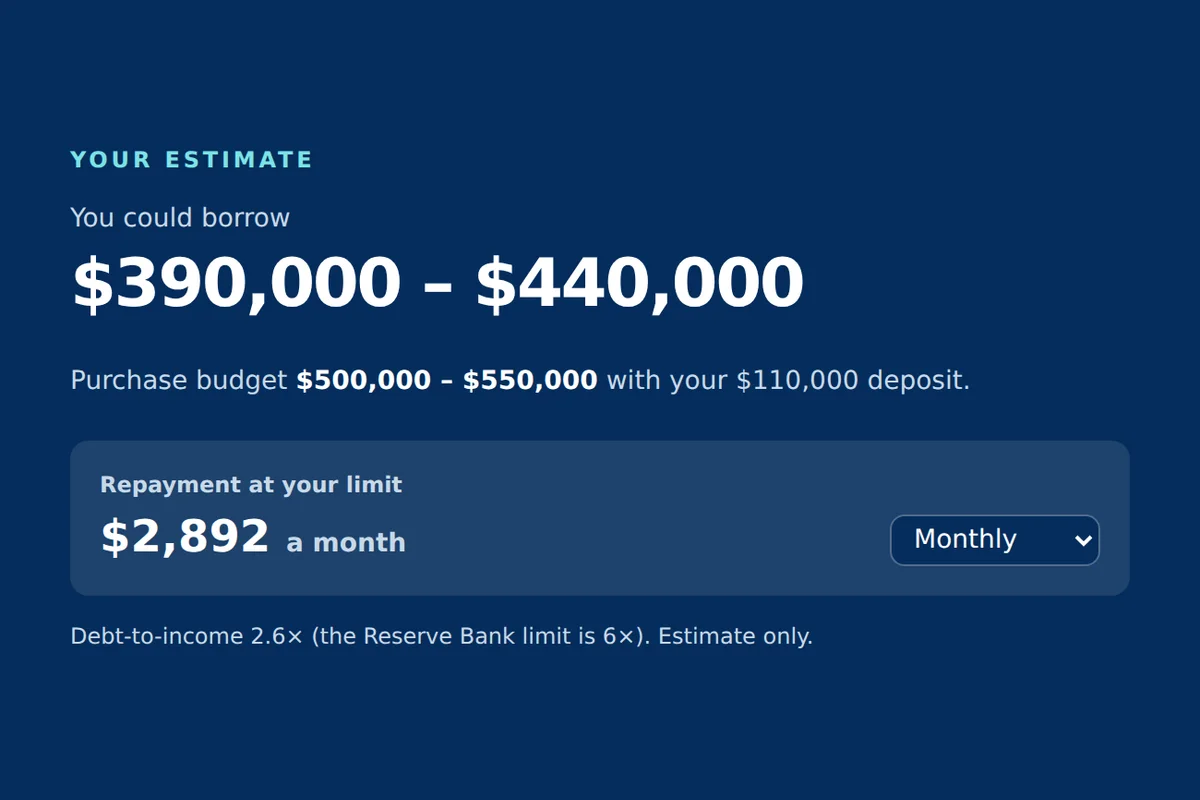
You could borrow

$390,000 – $440,000

Purchase budget $500,000 – $550,000 with your $110,000 deposit.

Repayment at your limit

$2,892 a month

Debt-to-income 2.6× (the Reserve Bank limit is 6×). Estimate only.

What limits you

Three things cap the loan. The lowest one is your answer.

  • Repayments

    $1,107,205

    What your monthly surplus can repay

  • 6× income

    $1,020,000

    The Reserve Bank's limit: 6 times household income before tax, less what you already owe

  • DepositYour limit

    $440,000

    What your savings are the minimum deposit on

  • Your deposit sets your limit: $110,000 is 20% of a $550,000 home. More savings raise it.
  • Your target of $850,000 is $300,000 above your purchase budget.
  • Each $100 a month of debt lowers your repayments limit by about $15,215.

How Much Can I Borrow?: how it works

What this calculator shows you

How Much Can I Borrow? showing $390,000 – $440,000
  • Borrowing range and purchase budget, including your deposit
  • Repayment at your borrowing limit
  • Debt-to-income ratio against the Reserve Bank's 6 times limit
  • Which limit applies: repayments, 6 times income, or deposit
  • Tips, such as how much each $100 of debt repayments reduces your limit

How to use it

  1. Enter each applicant's income, and say whether incomes are before or after tax.
  2. Tick KiwiSaver membership and add dependants, then check the suggested living costs and replace them with your own.
  3. Add debt repayments, credit card limits, what you still owe on other debts, KiwiSaver balance and other savings.
  4. Tick the Kāinga Ora First Home Loan only if you are eligible (5% deposit), and add a target price if you have one.
  5. Read your range, then see which limit is holding you back.

Why use it

For your clients

  • Realistic expectations before house-hunting.
  • Shows exactly what to change: costs, debts, deposit or income.

For your business

  • The most searched home-loan question, answered on your site.
  • Clients arrive knowing their limits, so meetings start further along.

How it works

  • The loan is the lowest of three limits: what your monthly surplus services at the banks' average test rate over 30 years (from Rates Hub; 7% in the example below), six times gross household income less what you already owe, card limits included (a Kāinga Ora First Home Loan is exempt), and the loan your savings are the minimum deposit on (20%, or 5% with a First Home Loan).
  • Banks count 3% of your credit card limits as a monthly repayment, even if you owe nothing on them.
  • Tax is the IRD brackets per applicant plus the ACC earners' levy. KiwiSaver contributions count only for members, and a take-home income is grossed up so they are never deducted twice.
  • Living costs are your figure. The suggestion is the cautious end of the benchmarks New Zealand mortgage advisers use for bank minimums ($1,900 a month for one adult, $2,600 for a couple, plus $500 a dependant); dependants only shape that suggestion.
  • The range is 90% to 100% of the limit, rounded down to the nearest $10,000. A lender's own policy will differ.

Worked example: Tested at 7%, two applicants earning $95,000 and $75,000 before tax, both KiwiSaver members, with $3,500 of monthly living costs, $450 of debt repayments and $110,000 of savings, could borrow $860,000 to $950,000 and buy at $970,000 to $1,060,000, repaying $6,377 a month at the limit. Repayments, not income or deposit, set the limit.

Common questions

Why is the test rate higher than today's rates?
Banks check you could still afford repayments if rates rise, so each tests at its own rate above what it charges. The calculator opens on the average of the main banks' test rates, checked daily by Rates Hub, and you can type your lender's own.
What is the 6 times income limit?
The Reserve Bank limits how much banks lend to owner-occupiers above 6 times household income before tax (7 times for investors), counting everything owed, credit card limits included. Kāinga Ora First Home Loans and new builds are exempt, and banks can make a limited number of exceptions.
Can I use KiwiSaver for my deposit?
Usually yes for a first home, after three years of membership, leaving a small balance in the account. Check with your KiwiSaver provider.

Related calculators

  • BasicAll industries

    Income Target

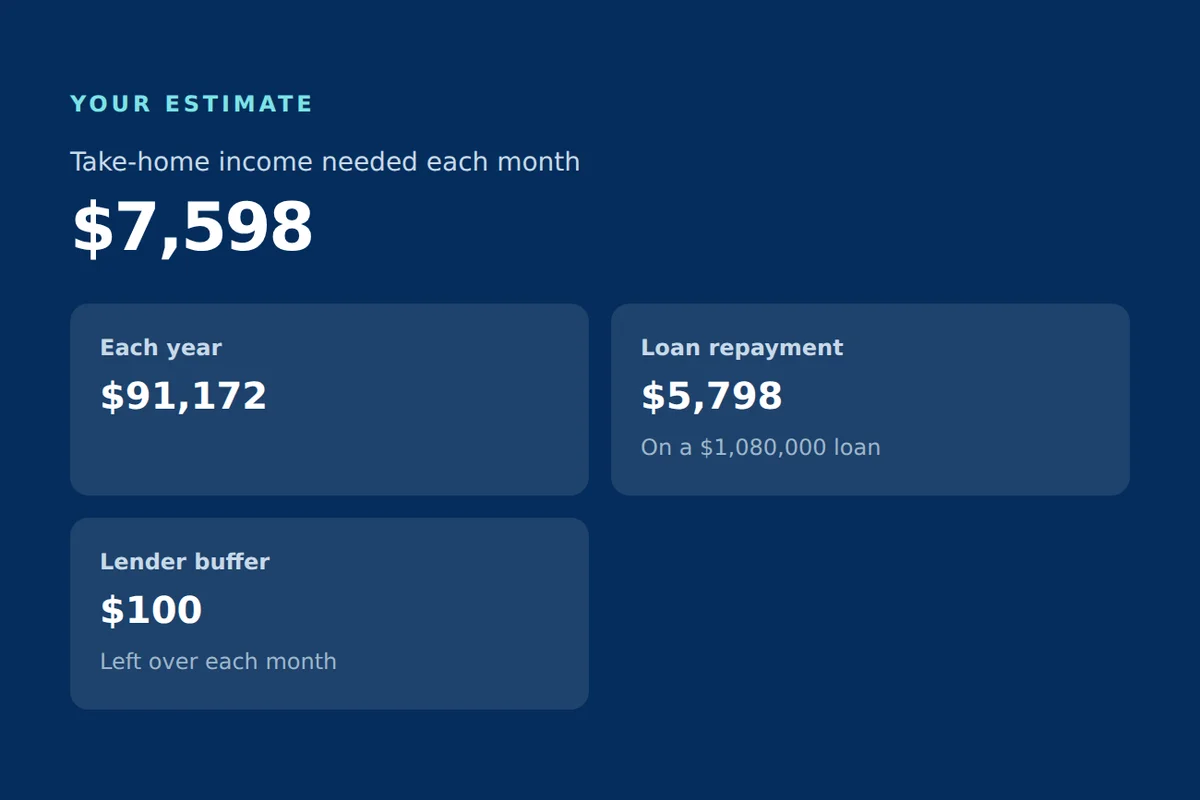
    How much income do I need for this home?

    Work backwards from a home price to the take-home income a lender would want to see.

    Shows: The monthly repayment, plus your other debts, living costs and a lender's $100 buffer: the take-home income needed each month and year.
  • BasicAll industries

    Repayment Check

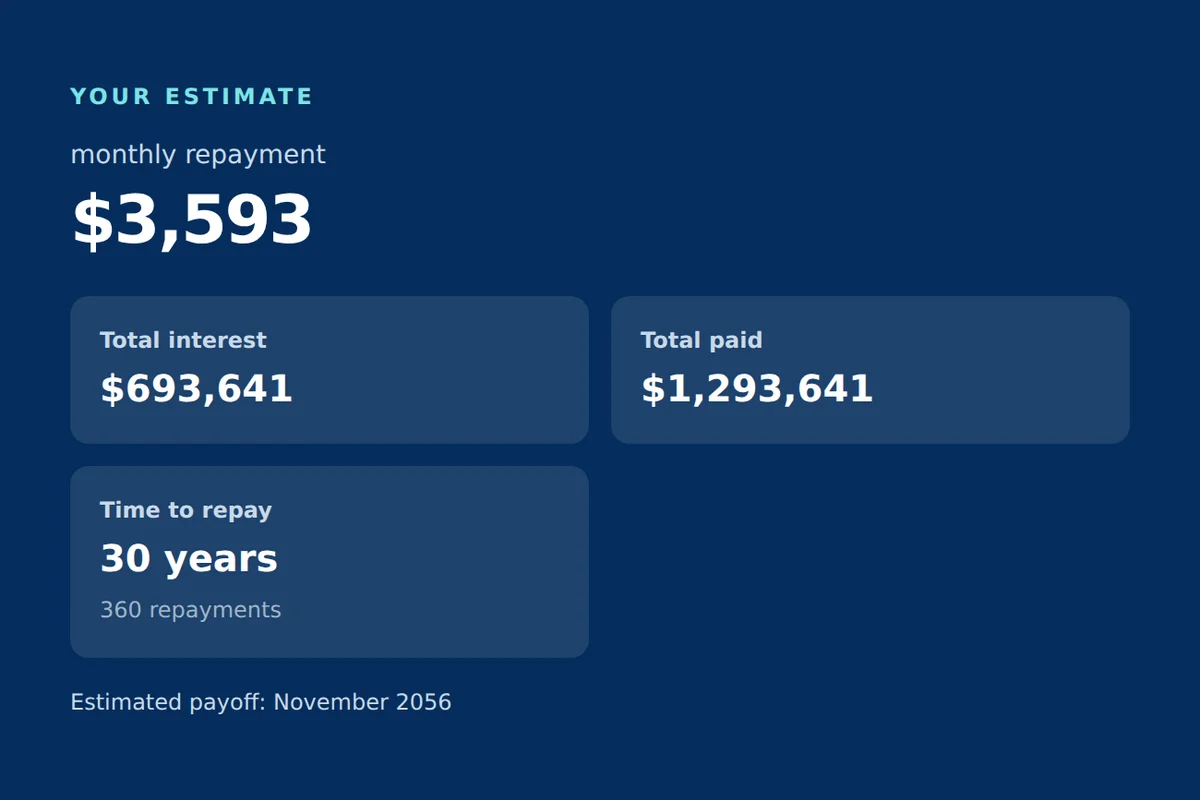
    What will my repayments be?

    Work out weekly, fortnightly or monthly repayments on any loan, plus the total interest and the date it is paid off.

    Shows: Weekly, fortnightly or monthly repayments, total interest and the full schedule, with an interest-only period if you want one.

  • EnhancedMortgage

    Rent or Buy?

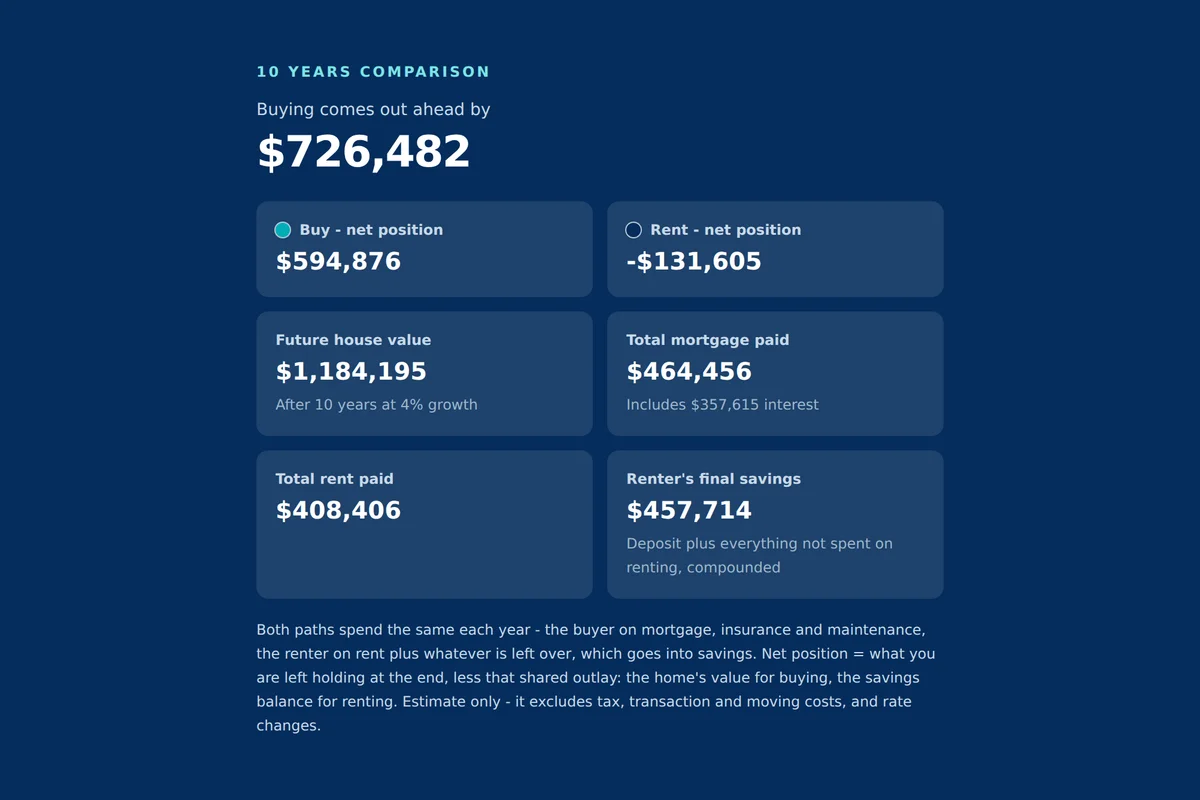
    Am I better off renting or buying?

    Compares the long-term position of buying a home against renting and investing the difference.

    Shows: Both paths year by year, and which leaves you with more at the end: the home's value or the renter's savings.

This calculator provides illustrative estimates based on your inputs and the stated assumptions. It is not financial advice. Consider consulting a qualified financial or mortgage adviser about your circumstances.

Last updated 6 October 2026 · Rates as at 17 Nov 2026