
Skip to content
EnhancedMortgage

Rent or Buy?Rent versus buy calculator

Buying and renting are compared over the period you choose, with both paths spending the same each year. The buyer pays the mortgage, insurance and maintenance and ends with the home; the renter pays rent, invests the deposit and the difference, and ends with the savings. The result is which path leaves you further ahead, and by how much.

Live comparison

Compare renting and buying side by side

Adjust the assumptions and see which path leaves you in the stronger position.

Property & loan

Percent of the price
Years
Per year
Per year

Ownership costs

Per year, on the house value

Renting

Usually 4x weekly rent
Rate the renter's savings earn
Years

Description

Compares the estimated net position from buying a home with renting and investing savings over the selected period.

Assumptions

  • Future-dollar estimate only; excludes inflation, tax, property rates, transaction/moving costs, and changes to inputs.
  • House value and ownership costs update yearly. Rent is 52 weeks plus bond in year 1, then grows with the house.
  • The loan is price less deposit, repaid yearly with principal and interest.
  • Both paths are assumed to spend the same each year. The renter invests the deposit, then each year pays rent and invests whatever the buyer spent above it (mortgage, insurance and maintenance). Those savings earn the savings rate and compound for the whole period.

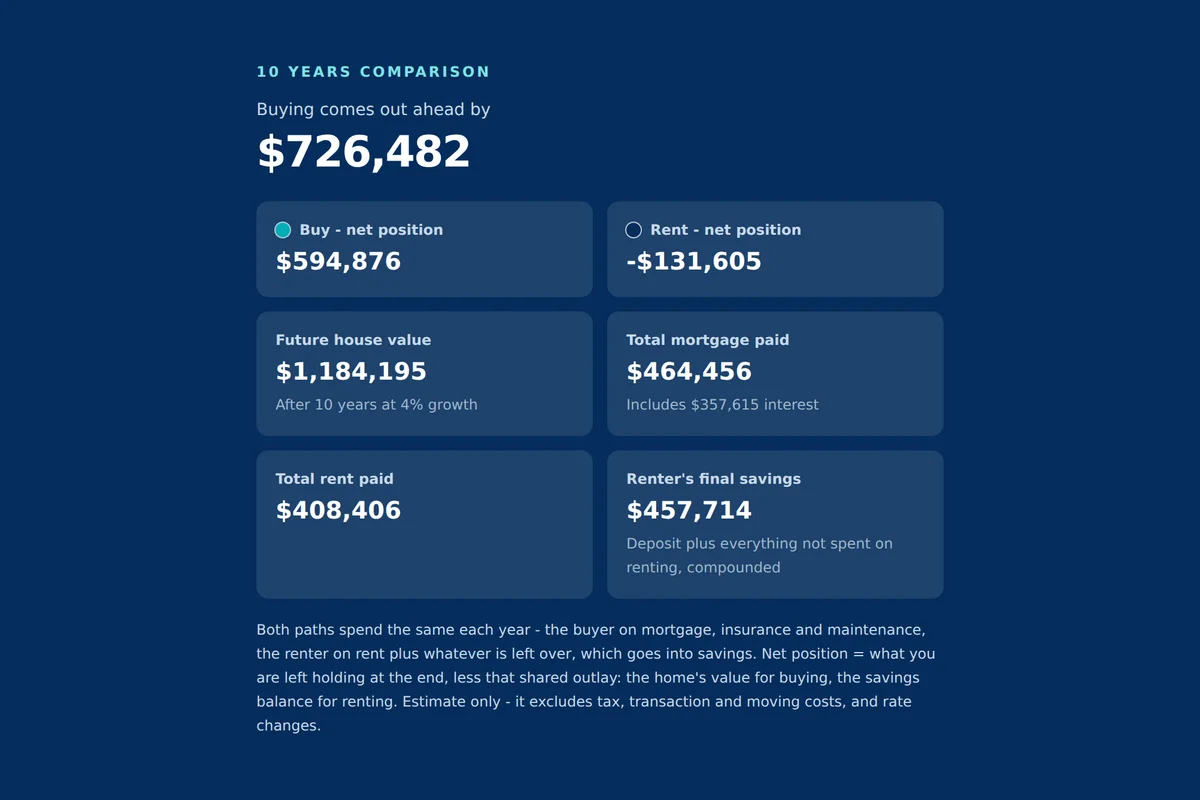
10 years comparison

Buying comes out ahead by

$726,482

Buy - net position

$594,876

Rent - net position

-$131,605

Future house value

$1,184,195

After 10 years at 4% growth

Total mortgage paid

$464,456

Includes $357,615 interest

Total rent paid

$408,406

Renter's final savings

$457,714

Deposit plus everything not spent on renting, compounded

Both paths spend the same each year - the buyer on mortgage, insurance and maintenance, the renter on rent plus whatever is left over, which goes into savings. Net position = what you are left holding at the end, less that shared outlay: the home's value for buying, the savings balance for renting. Estimate only - it excludes tax, transaction and moving costs, and rate changes.

Year-by-year breakdown

What buying costs each year against what renting costs and saves.

10 years
YearHouse valueInsuranceMaintenanceMortgageRentRenter investsRenter’s savings
1$832,000$2,400$8,000$46,446$36,400$20,446$186,846
2$865,280$2,496$8,320$46,446$35,152$22,110$216,429
3$899,891$2,596$8,653$46,446$36,558$21,136$246,222
4$935,887$2,700$8,999$46,446$38,020$20,124$276,195
5$973,322$2,808$9,359$46,446$39,541$19,071$306,314
6$1,012,255$2,920$9,733$46,446$41,123$17,976$336,542
7$1,052,745$3,037$10,123$46,446$42,768$16,837$366,841
8$1,094,855$3,158$10,527$46,446$44,478$15,653$397,167
9$1,138,649$3,285$10,949$46,446$46,258$14,421$427,475
10$1,184,195$3,416$11,386$46,446$48,108$13,140$457,714

Net position over time

Where each path leaves you at the end of each year across the comparison horizon.

Rent vs Buy projection

Both paths pay the same each year, so the gap is simply the home's value against the renter's savings balance.

Buy - net positionRent - net position
-$500K$0$500K$1.0M202720292031203320352036

What this calculator shows you

Rent or Buy? showing $726,482
  • Net position of buying versus renting over your chosen period
  • Future home value
  • Total mortgage paid and interest
  • Total rent and the renter's savings
  • Chart and year-by-year table

How to use it

  1. Enter the house price, deposit, mortgage rate, loan term and expected house price growth.
  2. Enter ownership costs: insurance and maintenance.
  3. Enter the weekly rent, the bond and what savings could earn.
  4. Choose the comparison period and read the result.

Why use it

For your clients

  • A fair, side-by-side comparison instead of "rent is dead money".

For your business

  • Useful for first home buyers who are still deciding.

How it works

  • The mortgage amortises yearly at the rate entered, and the house grows at the growth rate each year.
  • Both paths spend the same each year: the renter's savings start at the deposit and grow at the savings rate, plus whatever the buyer paid that year less the rent.
  • Each side's net position is its asset, the home or the savings, less that shared outlay, so the difference is the future house value less the renter's savings.
  • Inflation, tax, rates, transaction costs and rate changes are left out.

Worked example: An $800,000 house with a 20% deposit at 6% over 30 years, growing 4% a year, against $650 a week in rent with savings earning 4%: after 10 years the home is worth $1,184,195 and the renter's savings $458,311, so buying ends $725,884 ahead.

Common questions

What is left out?
Inflation, taxes, rates, transaction costs and rate changes.
Why does growth matter so much?
Small changes in house price growth make a big difference over 10 to 20 years. Try a few values.

Related calculators

  • EnhancedMortgage

    How Much Can I Borrow?

    How much could I borrow for my first home?

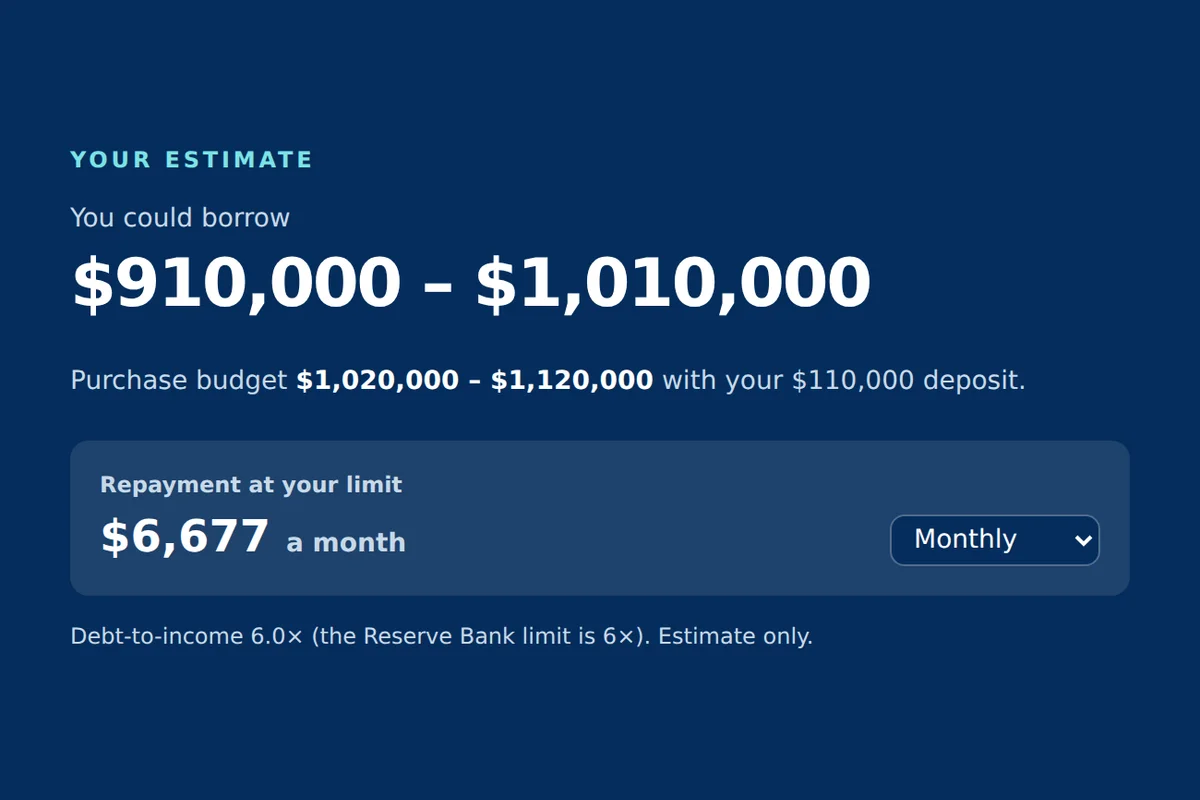
    Tests income, living costs and deposit against the three limits a New Zealand lender applies, and shows which one holds you back.

    Shows: A borrowing range and purchase budget from your income, costs and deposit, and which of the three lender limits - repayments, 6x income or deposit - decides it.
  • BasicAll industries

    Repayment Check

    What will my repayments be?

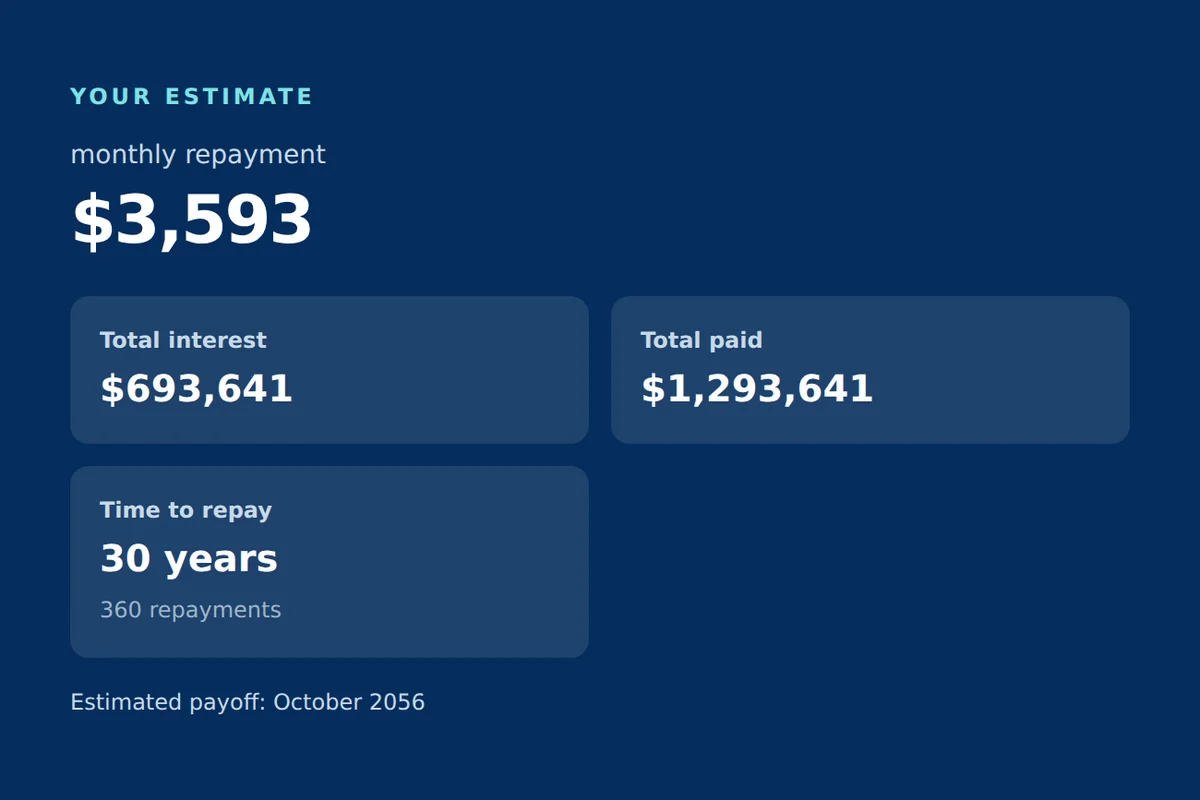
    Work out weekly, fortnightly or monthly repayments on any loan, plus the total interest and the date it is paid off.

    Shows: Weekly, fortnightly or monthly repayments, total interest and the full schedule, with an interest-only period if you want one.

  • BasicAll industries

    Income Target

    How much income do I need for this home?

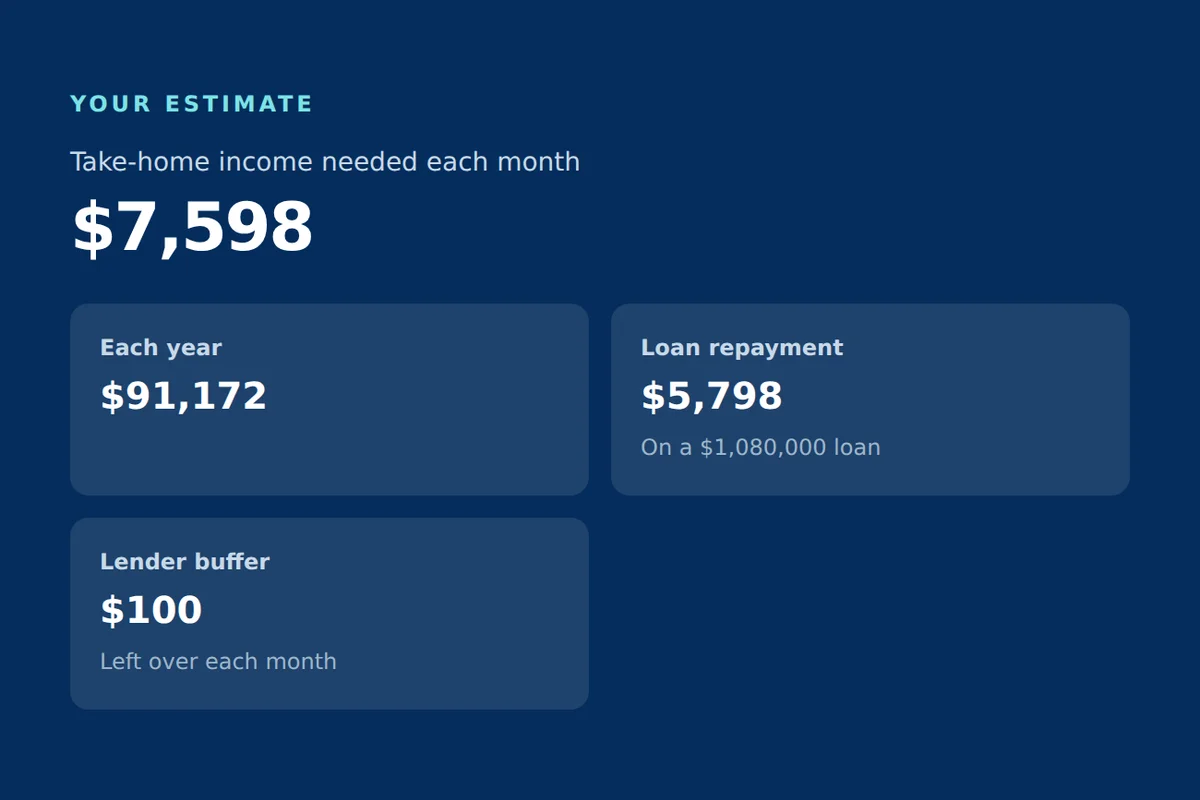
    Work backwards from a home price to the take-home income a lender would want to see.

    Shows: The monthly repayment, plus your other debts, living costs and a lender's $100 buffer: the take-home income needed each month and year.

This calculator provides illustrative estimates based on your inputs and the stated assumptions. It is not financial advice. Consider consulting a qualified financial or mortgage adviser about your circumstances.

Last updated 6 October 2026