Should you pay off your mortgage early or invest the difference?
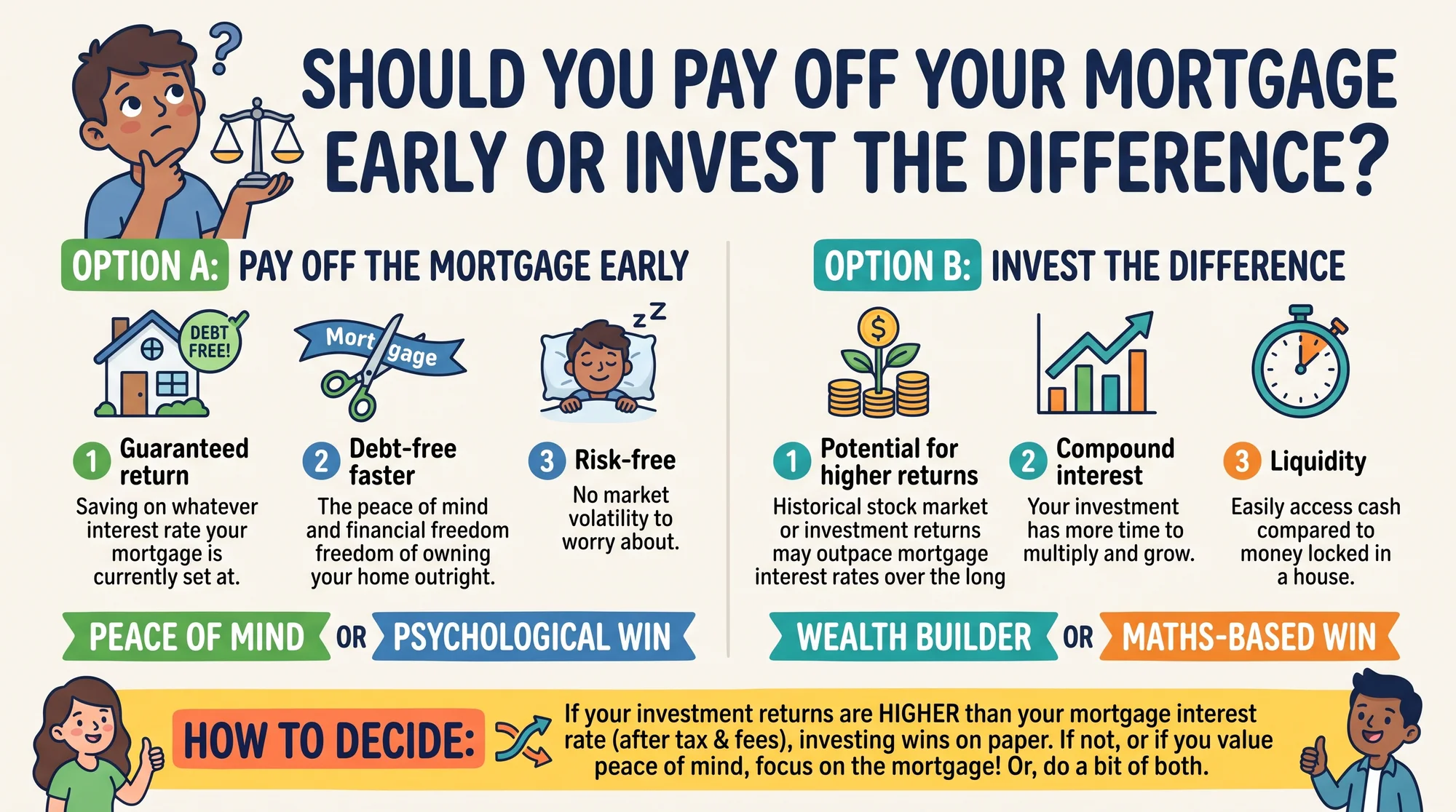
An extra dollar can reduce your mortgage or help build an investment portfolio. Both can improve your finances, but they do different jobs. Mortgage repayments reduce debt and future interest. Investing gives your money an opportunity to grow, with returns that can rise, fall or turn negative.
For a New Zealand homeowner, the useful question is: what would this money do for me after costs, and what uncertainty can I afford? Start with your actual mortgage rate, a realistic investment assumption and the date you might need the money.
What an extra mortgage repayment buys you
Interest is charged on the balance you owe. Reduce that balance sooner and less interest accrues. Keeping your regular repayment unchanged then directs more of each payment towards principal, bringing your mortgage-free date closer.
Suppose your home loan rate is 6% and you repay an extra $10,000 today. If that $10,000 would otherwise remain outstanding for a full year at the same rate, the simple interest saving is about $600. Actual savings depend on payment timing, how interest is calculated, future rates and any repayment charges. This is an illustration, not a current rate offer.
For an owner-occupied home loan whose interest is not tax-deductible, avoiding $600 of interest does not create $600 of taxable investment income. That makes the mortgage rate a useful benchmark when comparing alternatives. Rental-property or business borrowing can have different tax treatment.
The saving at the applicable loan rate is predictable once repayment charges are accounted for. It is not a promise of the same return for the rest of your mortgage: your rate may change when a fixed term ends.
Compare investment returns after tax and fees
A headline investment return is not the amount you keep. Allow for tax, fund charges, platform fees and transaction costs. The tax treatment depends on the investment and your circumstances; bank interest and a PIE fund are not taxed in the same way.
Here is a simple bank-interest comparison. At a hypothetical 33% tax rate, a deposit earning 6% before tax leaves 4.02% after tax, before fees. To match a 6% mortgage saving, it would need to earn about 8.96% before tax: 6% divided by 0.67. This calculation assumes all interest is taxed at 33%; it is not a general formula for shares, PIE funds or overseas investments.
An investment expected to return more than your mortgage rate may still lose money. Compare a cautious scenario as well as an optimistic one. A small expected advantage can disappear through fees, a poor year or selling earlier than planned.
Protect access to cash first
Before making a large extra repayment, allow for emergencies, home maintenance and planned spending. Money paid into a standard mortgage is not automatically available to withdraw. Access may require a new lending application and approval.
Investments can also be awkward emergency funds. A share portfolio might be down when you need it, a term deposit may restrict early withdrawal, and retirement savings have withdrawal rules. Choose where to hold your buffer based on when you need access and how much uncertainty you can accept.
An offset mortgage can keep eligible savings accessible while reducing the balance on which interest is charged. Compare the rate on the offset portion, fees and the savings balance you can realistically maintain. Use Offset Saver to explore that trade-off.
When paying down the mortgage may fit
You value a more predictable saving and lower debt.
You want to reduce commitments before retirement or an income change.
Investment losses would make it difficult to stick with your plan.
You already have an accessible cash buffer and can repay extra without a charge that outweighs the benefit.
Check higher-interest debts too. A credit card or personal loan may cost more than your mortgage, so compare those rates before directing all spare money into the home loan.
When investing alongside the mortgage may fit
Investing can suit money intended for a long-term goal when you can keep making mortgage payments, handle market falls and leave the investment in place. Diversification can spread exposure beyond your home, but it cannot eliminate losses.
Consider your existing retirement contributions separately. Employer contributions and scheme benefits may change the comparison, while withdrawal restrictions change when the money is available. Check your own eligibility and scheme terms before reducing contributions.
You can also divide your surplus. For example, part of a sustainable $500 monthly surplus could go to extra repayments and part to long-term investing. That is a budgeting illustration, not a recommended allocation. The useful split is one you can maintain through expensive months.
Check your loan terms before paying extra
Fixed loans can limit additional repayments and charge for exceeding the allowance or ending the fixed period early. Ask your lender for the permitted amount and a written cost estimate. The end of a fixed term can be a useful time to review a lump-sum repayment and your next loan structure.
If your rate falls, consider whether you can keep paying the old repayment rather than reducing it. First check affordability and your lender's repayment rules.
Put your own plan into numbers
Use Mortgage-Free Date to compare your current payment with an extra regular repayment or lump sum. Record the interest saved and the change in payoff date. That calculator models debt repayment; it does not forecast investment performance.
For an investment comparison, use the same starting amount, monthly contribution and time horizon, with returns after tax and fees. If comparing long-term wealth, include what happens to the repayments freed up after the mortgage is cleared. Otherwise the two paths have different budgets.
Review the plan when your rate, income or goals change. A financial adviser can help assess investments and risk; a mortgage adviser or lender can explain the loan's repayment conditions.
Sources and further reading
ANZ: Ways to reduce mortgage interest costs - one lender's terms; check your own agreement.
General information, not personalised financial advice. Examples are hypothetical and do not predict investment returns.