How much can I borrow in New Zealand?
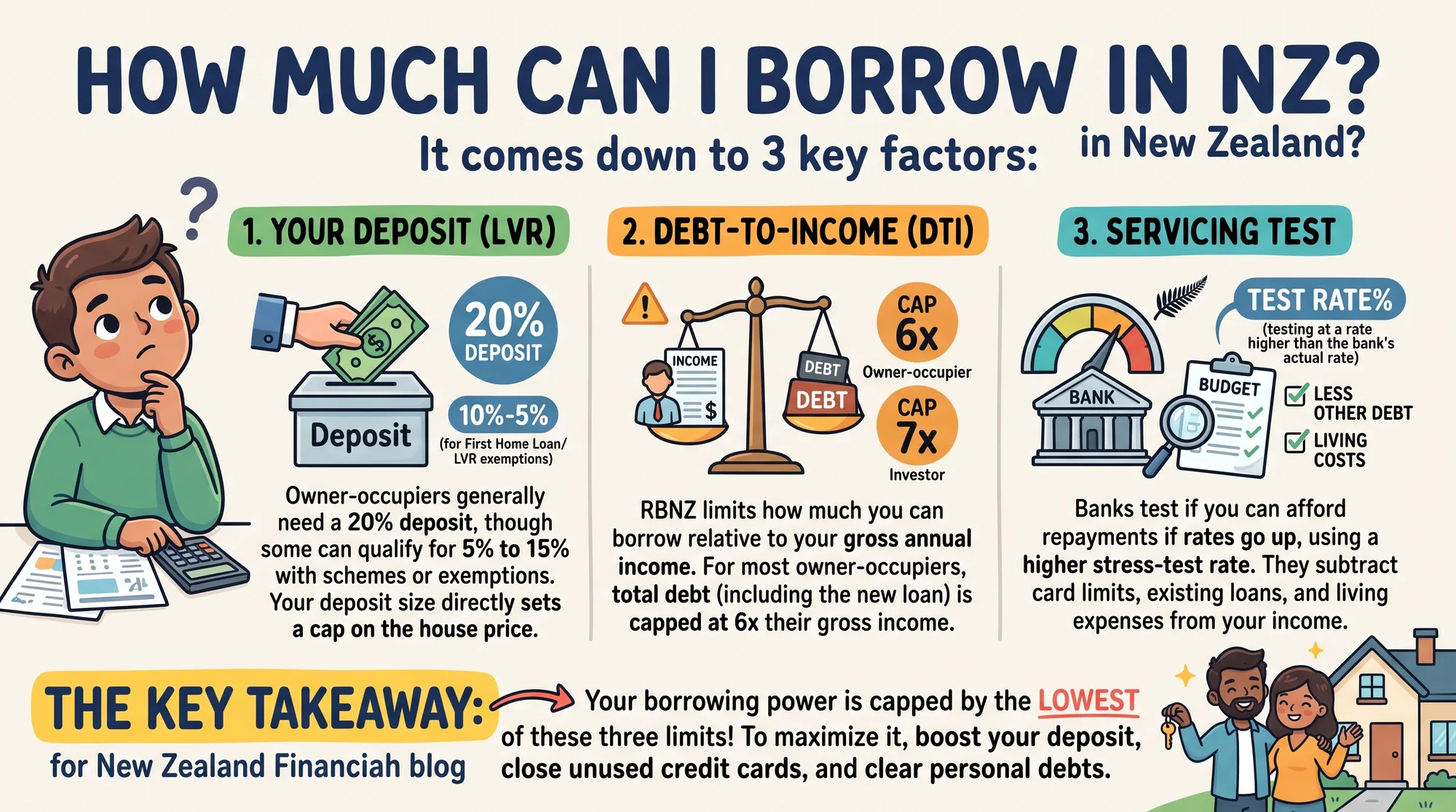
Ask a bank how much you can borrow and the answer is the lowest of three numbers. One comes from your income after costs, one from a Reserve Bank rule, and one from your deposit. Knowing which of the three is holding you back tells you what to change.
Limit one: what you can repay
The lender takes your household income, deducts tax and KiwiSaver, then takes off your living costs and any other loan or card repayments. What is left is your surplus, and the loan you can borrow is the one whose repayments fit inside it.
The catch is the rate. Banks do not test your repayments at the rate they will charge you but at a higher assessment rate, so that you could still pay if rates rose. Our calculator opens on the average of the main banks' test rates, checked daily by Rates Hub (6.88% as this was written), over 30 years; each bank's own figure differs and moves with the market, and you can type your lender's.
Limit two: six times your income
Since 1 July 2024 the Reserve Bank has limited how much banks lend to people whose total debt would be more than six times their gross household income (seven times for investors). Banks may make a small share of exceptions, no more than 20% of new lending, but for most borrowers the six-times line is the ceiling. Two incomes of $95,000 and $75,000 make $170,000, so this limit alone caps the loan at $1,020,000, whatever the repayment maths says.
Limit three: your deposit
A bank can lend only a limited share of its owner-occupier loans to people with less than a 20% deposit: 25% of new lending from 1 December 2025 (and 10% of investor lending below a 30% deposit). So most buyers need 20% of the price in deposit, which means the loan can be at most four times the deposit. With a 5% deposit through the First Home Loan scheme, which has income caps, the same savings stretch much further; the calculator has a switch for it.
A worked example
Tested at 7%, two applicants earning $95,000 and $75,000 before tax, both KiwiSaver members, with $3,500 of monthly living costs, $450 of debt repayments and $110,000 of savings, could borrow about $860,000 to $950,000 and would repay $6,377 a month at the top of that range. It is the repayments, not the income rule or the deposit, that set the limit. Clearing the $450 of repayments would lift it; so would lower living costs.
Run your own numbers
Enter your incomes, costs, debts and savings below. The result shows the range, the repayment at the limit, your debt-to-income ratio, and which of the three limits applies to you.
Borrowing estimate
How much could I borrow for my first home?
Your income, costs and deposit against the three limits a lender applies.
Your estimate
You could borrow
Purchase budget $1,020,000 – $1,120,000 with your $110,000 deposit.
Repayment at your limit
$6,677 a month
Debt-to-income 6.0× (the Reserve Bank limit is 6×). Estimate only.
What limits you
Three things cap the loan. The lowest one is your answer.
RepaymentsYour limit
$1,015,918
What your monthly surplus can repay
6× income
$1,020,000
The Reserve Bank's limit on your household income
Deposit
$2,090,000
What your savings are the minimum deposit on
- What you can repay each month sets your limit. Lower costs or debts, or a higher income, raise it.
- Your target of $850,000 is within your purchase budget.
- Each $100 a month of debt lowers your repayments limit by about $15,215.
What the number does not tell you
It is a guide to what a lender might approve, not an approval. Each bank has its own living-cost floors, test rate and view of your income.
Living costs are your own figure. Put in what you actually spend; a bank will check it against your statements.
Borrowing the maximum is not the same as being comfortable. Try the repayment at a rate two points higher before you commit.
If you have a price in mind and want to work back to the income it needs, the Income Target calculator does that. For the repayment on a given loan, use Repayment Check.