Fixed or floating: how to choose your home loan rate
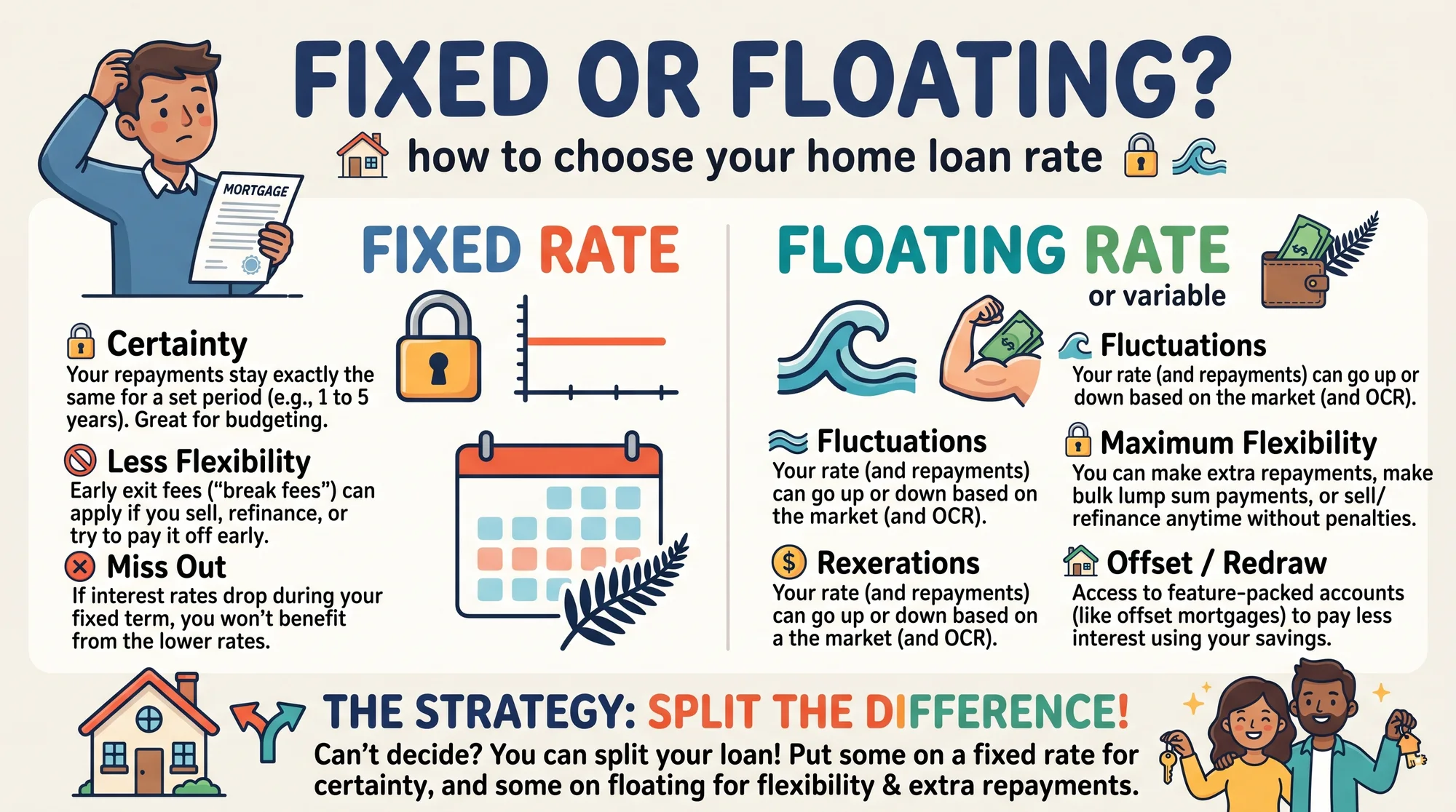
Choosing a home loan rate affects both your repayments and what you can do with the loan. A fixed rate offers certainty for an agreed period. A floating rate can change, but usually allows more flexibility for extra repayments. A split loan lets different portions serve different needs.
Start with your budget and plans. How much repayment uncertainty can you manage? Will you receive a bonus, sell your home or make a large repayment? The cheapest advertised rate is only one part of that decision.
How a fixed rate works
A fixed rate applies for an agreed period within the overall loan term. A two-year fixed period on a 25-year mortgage does not mean the mortgage is paid off in two years. It means the rate is set for those two years, after which you need another rate arrangement.
For a standard principal-and-interest loan, scheduled repayments are generally stable during the fixed period, provided you do not change the loan. This can make budgeting easier when there is little room for a payment increase.
You may be able to increase payments or make a lump-sum repayment within an allowance. Beyond that allowance, an early repayment charge may apply. Selling, refinancing or restructuring during the fixed period can also create costs. The rules vary by lender and agreement, so ask for a quote before making a change.
Fixing also means you may not benefit immediately if market rates fall. A longer fixed period buys longer certainty, but can be less convenient if your plans change.
How a floating rate works
A floating rate is variable. Your lender can change it, which changes interest costs and may change the required repayment. A falling rate can help your budget; a rising one can put it under pressure.
Floating loans generally offer greater freedom to pay extra or clear the balance. That can be useful for irregular income, a planned lump sum or a property sale. Confirm fees and conditions rather than assuming every change is free.
Compare the actual offers available to you. Floating can cost more than fixing, so flexibility has a price if you are not using it. Offset and revolving-credit products are often linked to variable rates, but they have their own account rules and require separate comparison.
Test what a rate change does to your budget
Consider a hypothetical $500,000 principal-and-interest mortgage with 25 years remaining. Using monthly payments and a constant annual rate divided by 12, the payment is approximately:
$2,923 a month at 5%.
$3,222 a month at 6%.
$3,534 a month at 7%.
The move from 5% to 7% adds about $611 a month. These rounded examples exclude fees and are not current lender offers. Actual lender calculations and payment timing may differ.
Use Repayment Check with your balance and remaining term. Try the offered rate, then a higher rate. Check whether the higher payment still leaves room for rates, insurance, maintenance and normal living costs.
How splitting the loan can help
You can put one portion on a fixed rate and another on floating. The fixed portion gives some repayment certainty; the floating portion gives room for extra payments. You can also fix separate portions for different periods, so the entire balance does not need a new rate on the same date.
Size the flexible portion around money you expect to pay off or savings you can consistently hold against an eligible offset loan. A large floating balance costs money if the rate is higher and you never use the flexibility.
For example, suppose you expect to direct $20,000 of surplus income into your mortgage over the next year. A $20,000 floating portion might give that money a clear destination while the remainder stays fixed. That is a structure to discuss with your lender, not a rule: repayment allowances on a fixed loan may already meet your needs, and income may arrive later than expected.
Work out the cost of flexibility
Suppose a $50,000 floating portion has a rate one percentage point above the fixed alternative. On an unchanged balance, that difference costs roughly $500 in interest over a year, before fees. If you repay the balance during the year, the extra cost reduces as the balance falls.
Ask what that extra cost buys you. It may be worthwhile if you expect a substantial repayment or need access through a suitable loan product. It may be unnecessary if you have no planned extra payments and the fixed loan's allowance is sufficient.
An offset account needs its own calculation: eligible savings reduce the interest-bearing balance, but the loan may carry a higher rate. Offset Saver helps compare that arrangement with a standard fixed mortgage.
Choose a fixed period around your plans
A shorter fixed period brings the next rate decision sooner. A longer period postpones that uncertainty, but may make an early move more costly. Neither guarantees the lowest total cost, because future rates are unknown.
Think about when you might move, change jobs, take parental leave, retire or receive a lump sum. If a sale is likely during the fixed period, ask what happens to the loan and whether any transfer option is available. Do not assume it will be approved.
Avoid choosing a term solely because you expect rates to move in one direction. A loan structure should remain affordable if that forecast is wrong.
Before your current fixed period ends
Confirm the expiry date and what rate applies if you take no action.
Ask for available offers, fees and the deadline to accept them.
Review your balance, remaining term and repayment amount.
Confirm how much you can repay extra and when a lump sum can be applied.
Check any break costs or cashback repayment conditions before switching lenders.
Compare offers using the same balance and remaining loan term.
Extending the loan term can lower the monthly payment while increasing the years you pay interest. Make that trade-off explicit when assessing a refinance.
Use the right calculator for the question
Today's Best Rates shows published fixed-rate comparisons. Check the as-at date and confirm eligibility with the lender; the table does not establish which structure suits your circumstances or provide a personalised floating-rate offer.
Use Repayment Check for affordability, Offset Saver for linked savings, and Best Deal Check if you are comparing refinancing scenarios. A refinance estimate does not choose between fixed and floating for you. Read each calculator's assumptions, then discuss the proposed structure and costs with your lender or mortgage adviser.
Sources and further reading
ANZ: Ways to reduce mortgage interest costs - an example of lender-specific repayment conditions.
General information, not personalised financial advice. Rates in the examples are hypothetical; loan terms and eligibility vary.