First home buyers: deposit, KiwiSaver and the First Home Loan
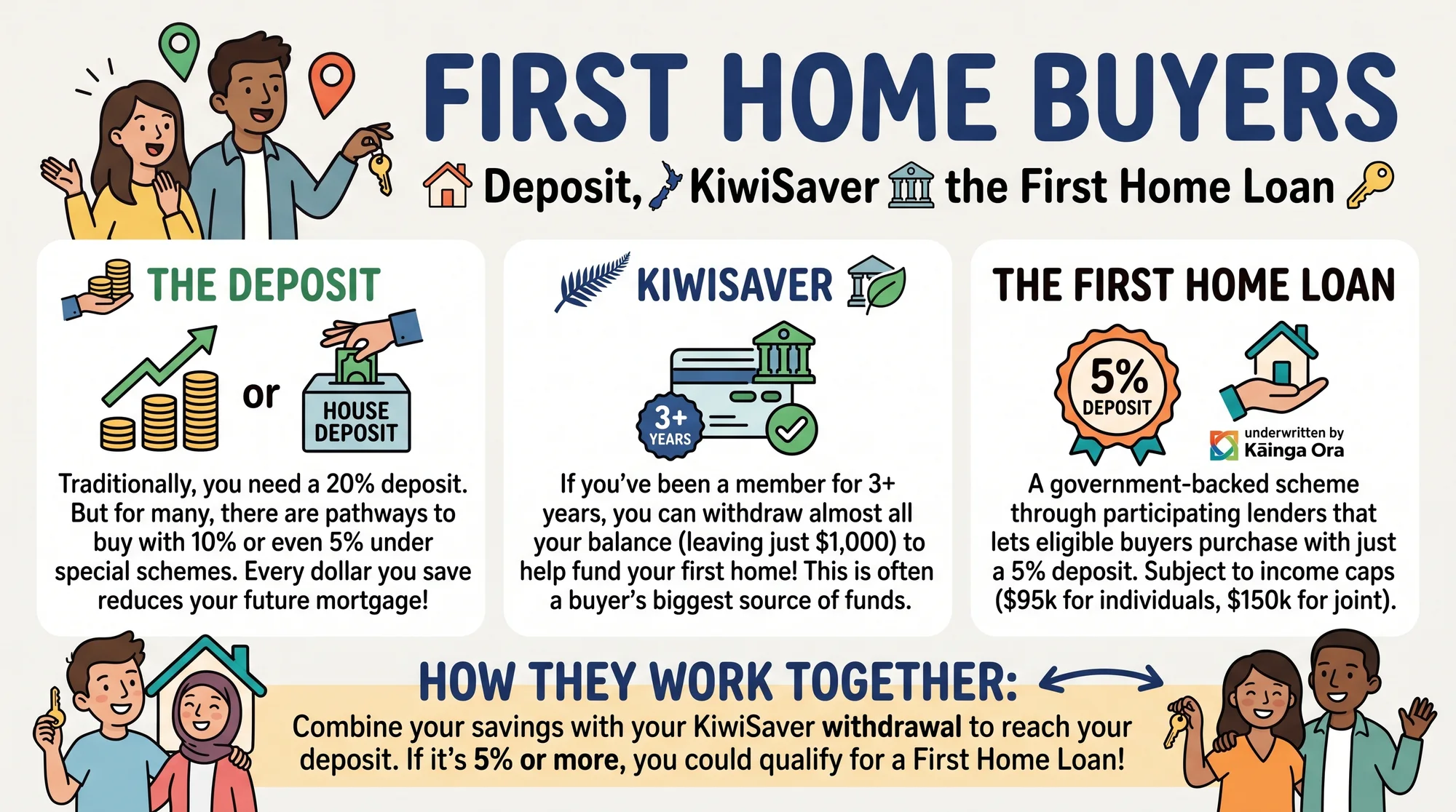
The deposit is the part of buying a first home that feels least in your control. This guide covers the three questions buyers ask most: how much deposit a bank wants, what KiwiSaver can contribute, and whether the First Home Loan's 5% deposit is open to you. Then it turns the price you have in mind into the income you would need.
How much deposit do you need?
The standard answer is 20% of the price. The Reserve Bank lets banks make only 25% of their new owner-occupier lending to borrowers with less than that (from 1 December 2025), so a low-deposit loan is possible but rationed, and it usually costs a higher rate or a low-equity fee. A 10% deposit is a common compromise; below that, most buyers go through the First Home Loan.
Remember that the deposit is not the only cash you need. Keep money aside for a lawyer, a builder's report, valuation if the bank asks for one, moving costs and the first few repayments.
Using KiwiSaver
After three years of membership you can usually withdraw most of your KiwiSaver balance towards your first home, leaving $1,000 in the account. The withdrawal goes to your lawyer, not to you, and the property has to be one you will live in. Apply to your KiwiSaver provider a few weeks before settlement, and ask for a pre-approval letter earlier so the bank can count it as deposit.
The First Home Grant, which used to add up to $10,000 to a KiwiSaver withdrawal, closed to new applications in May 2024. If you were planning around it, your deposit has to come from savings and KiwiSaver alone.
The First Home Loan
The First Home Loan is underwritten by Kāinga Ora and offered through participating banks and lenders. Its point is a deposit of 5% instead of 20%. It has income caps (there is no longer a house price cap), and those caps were a topic in the September 2026 election, so check the current figures with Kāinga Ora before you count on it. There is a one-off lender's mortgage insurance premium, which can be added to the loan.
With a 5% deposit, the limit on what you can borrow usually becomes your repayments or the six-times-income rule rather than your savings. The How Much Can I Borrow? calculator has a First Home Loan switch, so you can see the difference it makes to your range.
What income does your first home need?
Working the other way round is often more useful: start from the price and find the income it needs. For a $1,200,000 home with a 10% deposit at 5% over 30 years, the repayment is $5,798 a month. Add $500 of other repayments, $1,200 of living costs and the $100 a month buffer a lender expects, and the take-home income needed is $7,598 a month, or $91,172 a year.
Change the price, the deposit or the rate below and watch the income move.
Live estimate
Work out the income a loan needs
Enter the home, the loan and your outgoings to see the take-home income a lender would want to see.
Your estimate
Take-home income needed each month
Each year
Loan repayment
On a $1,080,000 loan
Lender buffer
Left over each month
Take-home (after-tax) income. Lenders look for at least $100 a month left over after all debts and expenses. Estimates only - lenders apply their own test rates and expense figures.
Three things to do before you apply
Get the KiwiSaver pre-approval letter and your savings history together; a bank wants to see the deposit was saved, not borrowed.
Clear or close the small debts. Every $100 a month of card or car repayments takes thousands off what you can borrow.
Test the repayment at a higher rate than today's. Your first fixed term will end, and the next rate is unknown.
When you have a figure, the How Much Can I Borrow? calculator will tell you whether a bank's three limits agree, and which one to work on if they do not.